Seiko Lord Matic 5606-8110: Dial, Crystal and Buying Priorities
Buy the Seiko 5606-8110 for an intact gradient dial, correct faceted crystal and sharp 36 mm steel case, not for an unsupported originality claim.
We auction more than 100 vintage watches a week.
Get first access: new Seiko 5606-8110 drops and alerts before auctions end.
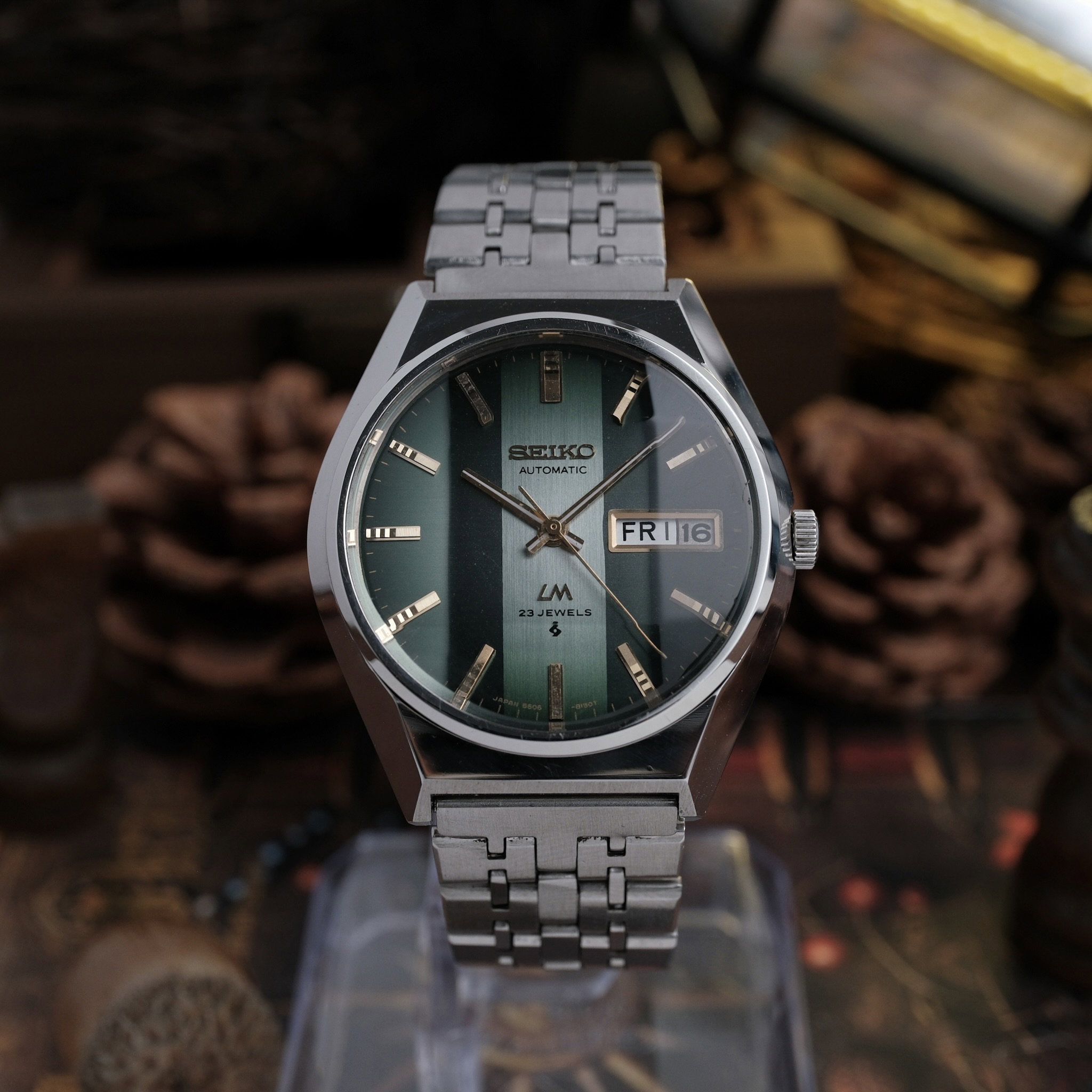
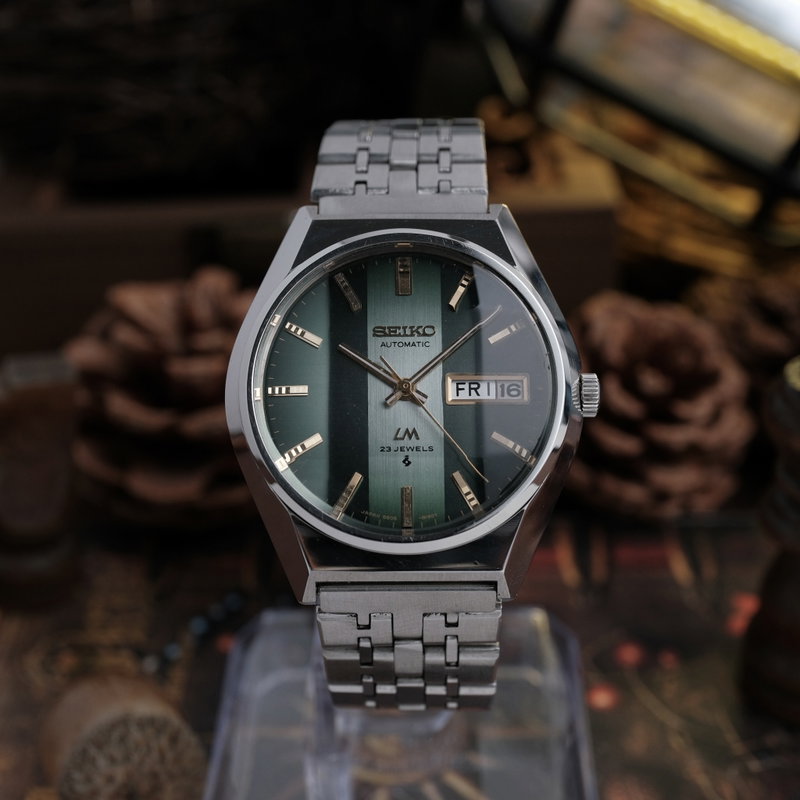
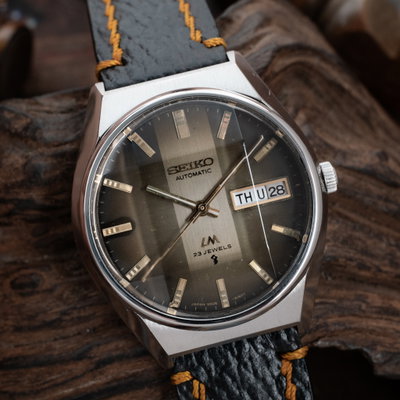
Browse 15 live Seiko auctionsThe Lord Matic 5606-8110 is defined by a combination that Seiko buyers can identify across the room: a 36 mm stainless-steel case, a gradient sunburst dial and a vertically faceted crystal. Known 1975 examples range from bronze and taupe-grey to emerald green, with darker edges changing the dial's appearance as the crystal breaks up the light.
The buying decision rests on three parts surviving together. A clean gradient dial carries the largest share of the value, the correct faceted crystal supplies the reference's visual structure, and sharp case lines keep the geometry intact. Between a polished example with a clean dial and a sharper case with a refinished dial, take the sharper case only if the dial is also honest - a redial costs more than softened edges to put right because it cannot be reversed.
Reference
5606-8110
Model
Lord Matic
Known production year
1975-1975
Case diameter
36 mm, excluding the crown on recorded examples
| Case material | Stainless steel |
| Movement | Automatic caliber 5606 or 5606A in recorded descriptions |
| Recorded dial colours | Bronze, taupe-grey, brown and emerald green gradients |
| Crystal | Vertically faceted crystal |
What it was built for
The 5606-8110 belongs specifically to 1975 in the watches handled, while caliber 5606 has a wider production window from 1968 to 1976. Its automatic movement, 36 mm stainless-steel case and applied baton furniture place the emphasis on a compact dress format, but the gradient dial and faceted crystal make it far less restrained than a plain silver-dial watch.
The crystal is not incidental decoration. Its vertical facets divide reflections across bronze, taupe-grey, brown and emerald-green dials, while the sunburst or brushed surfaces move from a lighter centre to a darker perimeter. A conventional replacement crystal may protect the watch, but it changes the defining optical effect and should trade at a discount to a correct faceted example.
Where the value sits
Dial integrity creates the widest spread between examples. The colour matters less than an untouched surface with a coherent centre-to-edge gradient, intact applied markers and printing that has not been refinished. Bronze, taupe-grey, brown and emerald green are all recorded, so colour alone neither proves authenticity nor supports a rarity premium without a production denominator.
The case comes next. Sharp planes and clear transitions support the angular design, while repeated polishing leaves soft or mushy edges that no service can recreate. Crystal damage also matters more here than on an ordinary Lord Matic because deep scratches interrupt the vertical facets; an incorrect smooth replacement removes a reference-specific component rather than merely substituting a consumable.
Dating and serials
Every 5606-8110 handled for this page dates to 1975, and the page therefore does not support a broader reference production span. The caliber 5606 production window runs from 1968 to 1976, but that window dates the movement family, not this case reference and not an individual watch.
Movement descriptions have used both 5606 and 5606A, while one recorded example states 23 jewels. Those details should be read from the individual watch rather than applied indiscriminately to every 5606-8110. The service history of a used Seiko 5606-8110 is usually unknown without documentation, and the available caliber window cannot establish whether a movement and case left the factory together.
Dating this watch
| Serial range / caliber | Year | Note |
|---|---|---|
| 5606 | 1968-1976 | caliber production window |
Dating data comes from our decoder tables; treat years as approximate.
What to check before you buy
- Dial surface and printing: The dial should combine a lighter centre, darker perimeter and a visible sunburst or vertical-brushed structure. Flat colour or printing laid over disturbed texture is a redial warning, not attractive patina.
- Faceted crystal: The reference is recorded with a vertically faceted crystal that divides reflections across the gradient dial. A smooth crystal may be a service replacement, but it should not be presented as the same reference-specific component.
- Case geometry: The 36 mm stainless-steel case should retain clear planes and transitions. Soft or mushy edges indicate polishing, while uneven lug shapes can signal heavier metal removal rather than ordinary surface wear.
- Caseback reference: The watch should be identified as 5606-8110. A caseback carrying another reference conflicts with this reference and raises the possibility of a franken or married watch, even when the dial and movement look plausible.
- Movement identity: Recorded watches use automatic caliber 5606 or descriptions marked 5606A. A different caliber is a material mismatch; the 1968-1976 caliber window alone cannot prove that a 1975 case and movement originally shipped together.
- Hands and crown limits: The available evidence does not establish exact factory profiles for every hand or crown. Matching colour is not proof of originality, and a period-correct replacement remains a replacement; without documentation, further certainty would be speculation.
Other 5606-8110 examples we auctioned
13 Seiko 5606-8110 auctioned
More Seiko references
Related pages
Frequently asked questions
Ready to hunt for your own?
More than 100 vintage watches go under the hammer every week.