Seiko Lord Matic 5606-7320 buying guide
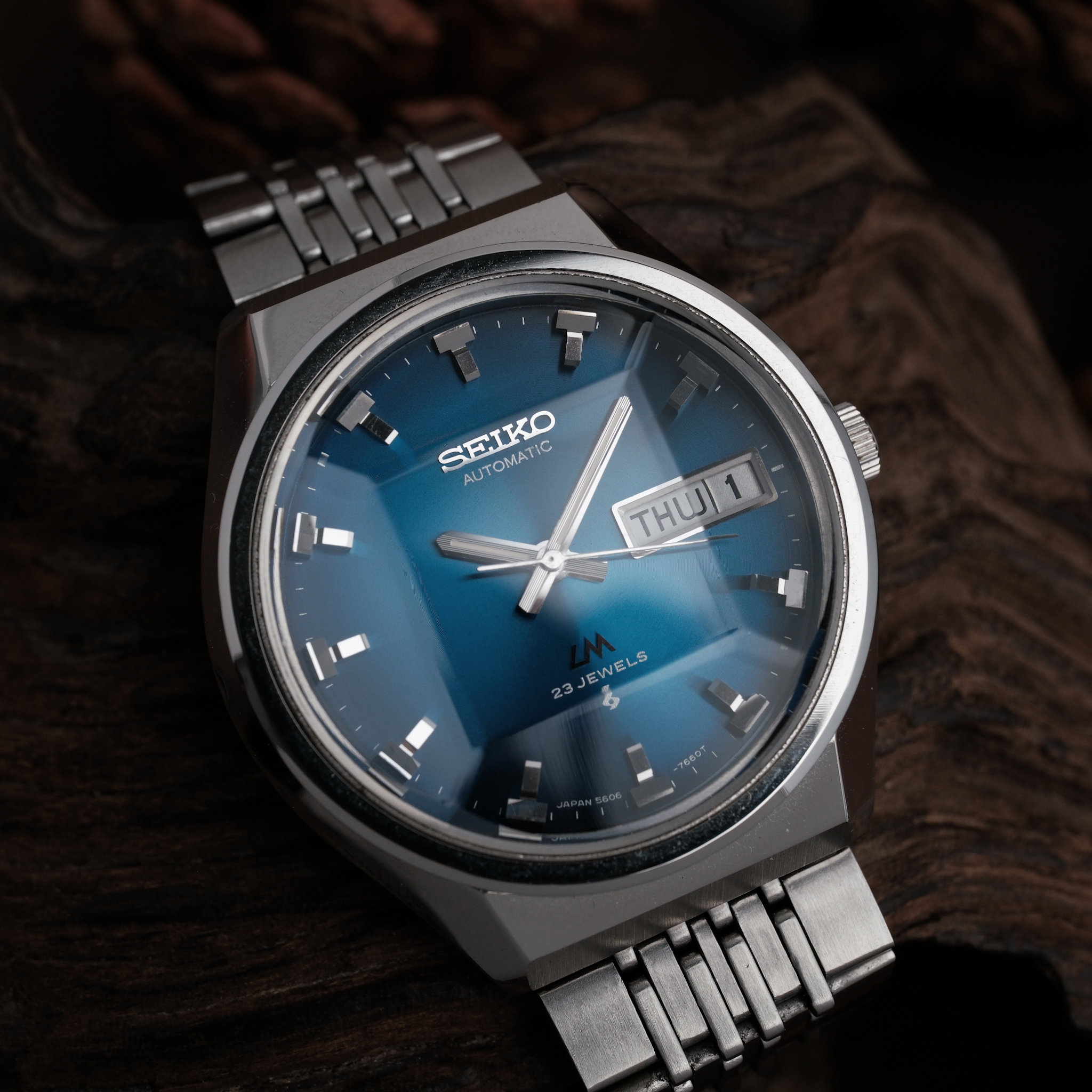
The Seiko Lord Matic 5606-7320 to buy has an honest gradient dial, defined case facets and the correct automatic caliber 5606A.
We auction more than 100 vintage watches a week.
Get first access: new Seiko 5606-7320 drops and alerts before auctions end.
Browse 27 live Seiko auctionsThe Lord Matic 5606-7320 turns a practical automatic day-date watch into a distinctly early 1970s object. Its 36 mm stainless-steel case, faceted crystal and strongly graded dials create the appeal, while caliber 5606A provides the mechanical identity. Known examples date from 1973 to 1974, so this is a tightly bounded reference rather than a loose family label.
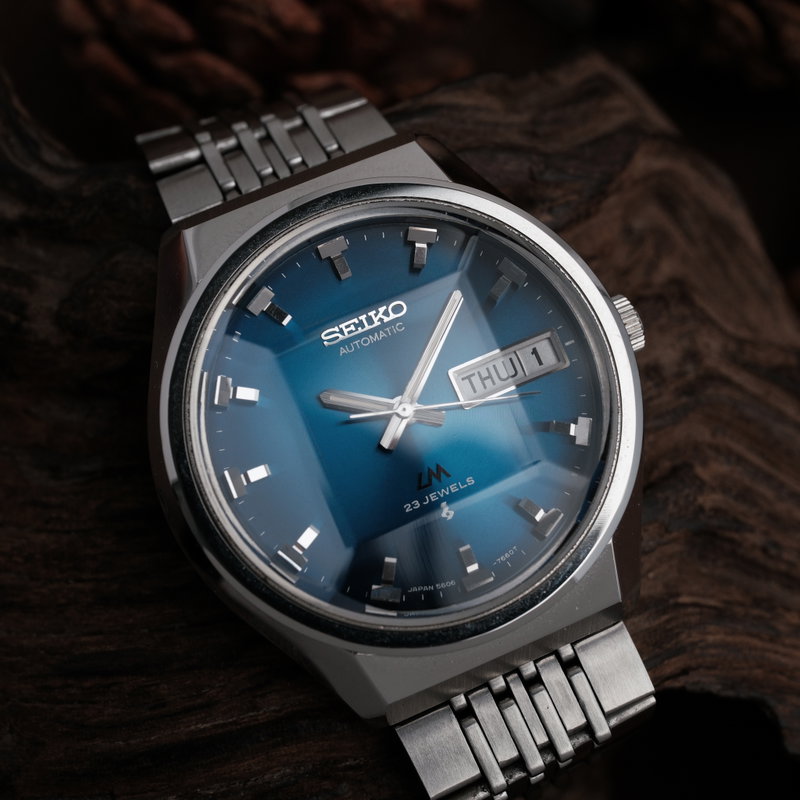
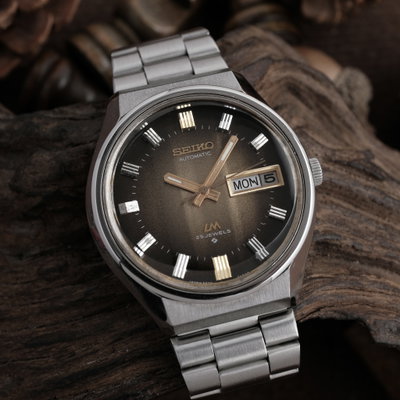
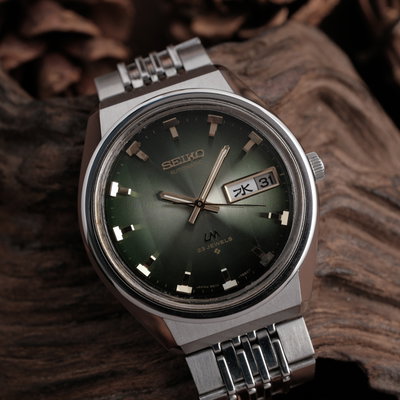
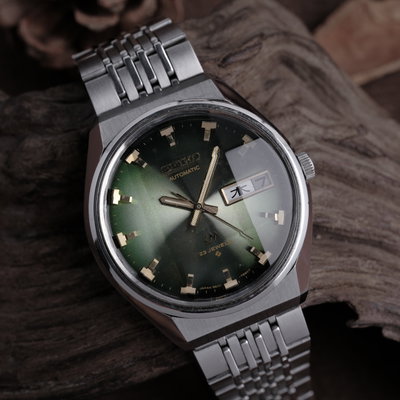
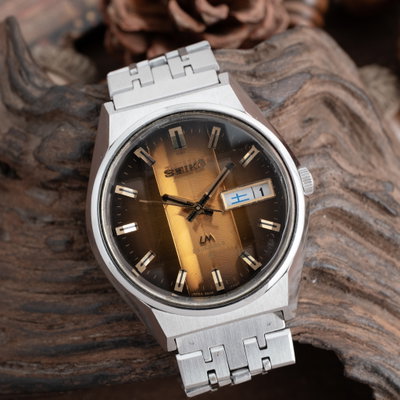
The version to want is not defined by one dial colour. Green, emerald, brown and amber-brown gradient dials are established, with vertical brushing on brown examples and applied faceted markers across the group. Buy the cleanest honest dial and the sharpest case before prioritising jewel count. On a vintage Seiko Lord Matic 5606-7320, a convincing gradient and intact geometry matter more than cosmetic shine.
Known production years
1973-1974
Case size
36 mm excluding the crown
Case material
Stainless steel
Movement
Automatic caliber 5606A
| Jewel executions | 23 jewels and 25 jewels |
| Crystal | Faceted crystal |
| Dial executions | Green, emerald, brown and amber-brown gradient |
| Calendar | Day-date, including an English and Kanji execution |
| Bracelet | Signed bracelet found on known examples |
The model landscape
The 5606-7320 remained consistent in its basic architecture: a 36 mm stainless-steel case, a faceted crystal and an automatic caliber 5606A. The visual spread sits in the dials. Green and emerald executions use deep edge shading, while brown and amber-brown versions can add vertical brushing, gold-tone markers and black inserts. An English and Kanji day wheel is also established on a brown 1973 example.
A signed bracelet makes the watch look complete, and several examples retain one, but the dial carries the larger premium. Between a bracelet-complete watch with a refinished gradient and a strap watch with crisp printing and undisturbed brushing, take the honest dial. The 23 and 25 jewel executions both occur under this reference, so jewel count alone does not identify a better 5606-7320 or justify overlooking mismatched parts.
On the wrist
At 36 mm excluding the crown, the 5606-7320 wears compactly by current standards without losing its 1970s presence. The faceted crystal and applied block markers add depth that a flat measurement cannot capture, while dark outer shading visually tightens the dial. Green is the more graphic choice; amber-brown and brown sit more quietly with tailoring, especially where gold-tone indices warm the display.
Legibility depends on contrast rather than diameter. Black centre stripes on the markers and matching dark details in the baton hands remain clear against the brown gradient, while the day-date gives the watch everyday utility. The signed bracelet strengthens the period look, but its condition should not excuse soft case facets. A strap can be changed; polished-away geometry cannot be returned.
What goes wrong
The costliest fault is a refinished dial. A redial can flatten the edge gradient, lose the vertical brushing found on brown and amber-brown versions, or leave printed text inconsistent with the applied Seiko and LM logos. Damage is different from patina: spotting, staining and moisture loss should be named directly. A genuine service dial is not the same as a redial, but the evidence here does not establish a service-dial configuration for 5606-7320.
Over-polishing is the next permanent loss because the case depends on distinct facets; soft transitions remove the architecture that makes this reference recognisable. A replacement plain crystal also changes the watch materially, since the faceted crystal contributes much of its light play. Bracelets can show stretch, and mixed dial, hand or marker combinations can create a franken watch even when every component is genuine Seiko. Without documentation, the service history remains unknown.
Dating this watch
| Serial range / caliber | Year | Note |
|---|---|---|
| 5606 | 1968-1976 | caliber production window |
Dating data comes from our decoder tables; treat years as approximate.
What to check before you buy
- Dial construction: Known 5606-7320 dials use a green, emerald, brown or amber-brown gradient with applied faceted markers and applied Seiko and LM logos. Brown examples can have vertical brushing, which a redial often flattens or replaces with uniform paint.
- Hands and marker coherence: Faceted baton hands belong visually with the applied block indices, and brown executions can use black centre details for contrast. Mismatched shapes, finishes or colour accents can indicate a franken assembly even when the parts are genuine Seiko.
- Case and crystal geometry: The reference has a 36 mm stainless-steel case and a distinctly faceted crystal. Soft case transitions point to polishing, while a plain replacement crystal removes a defining part of the known 5606-7320 configuration.
- Movement identity: The movement should be the automatic caliber 5606A, with both 23 and 25 jewel versions established. A different caliber conflicts with the handled examples, but jewel count alone should not be used to reject the watch.
- Calendar configuration: An English and Kanji day wheel is established on a brown 1973 example. That makes the configuration period-consistent for the reference, although the available evidence does not prove that every 5606-7320 left the factory with the same language pairing.
Other 5606-7320 examples we auctioned
18 Seiko 5606-7320 auctioned
Seiko · Lord Matic · 5606-7320 · 1973
Seiko · Lord Matic · 5606-7320 · 1973
Seiko · Lord Matic · 5606-7320 · 1973
Seiko · Lord Matic · 5606-7320 · 1973
Seiko · Lord Matic · 5606-7320 · 1974
More Seiko references
Related pages
Frequently asked questions
Ready to hunt for your own?
More than 100 vintage watches go under the hammer every week.