Seiko Lord Matic 5606-7240: the 1972 reference explained
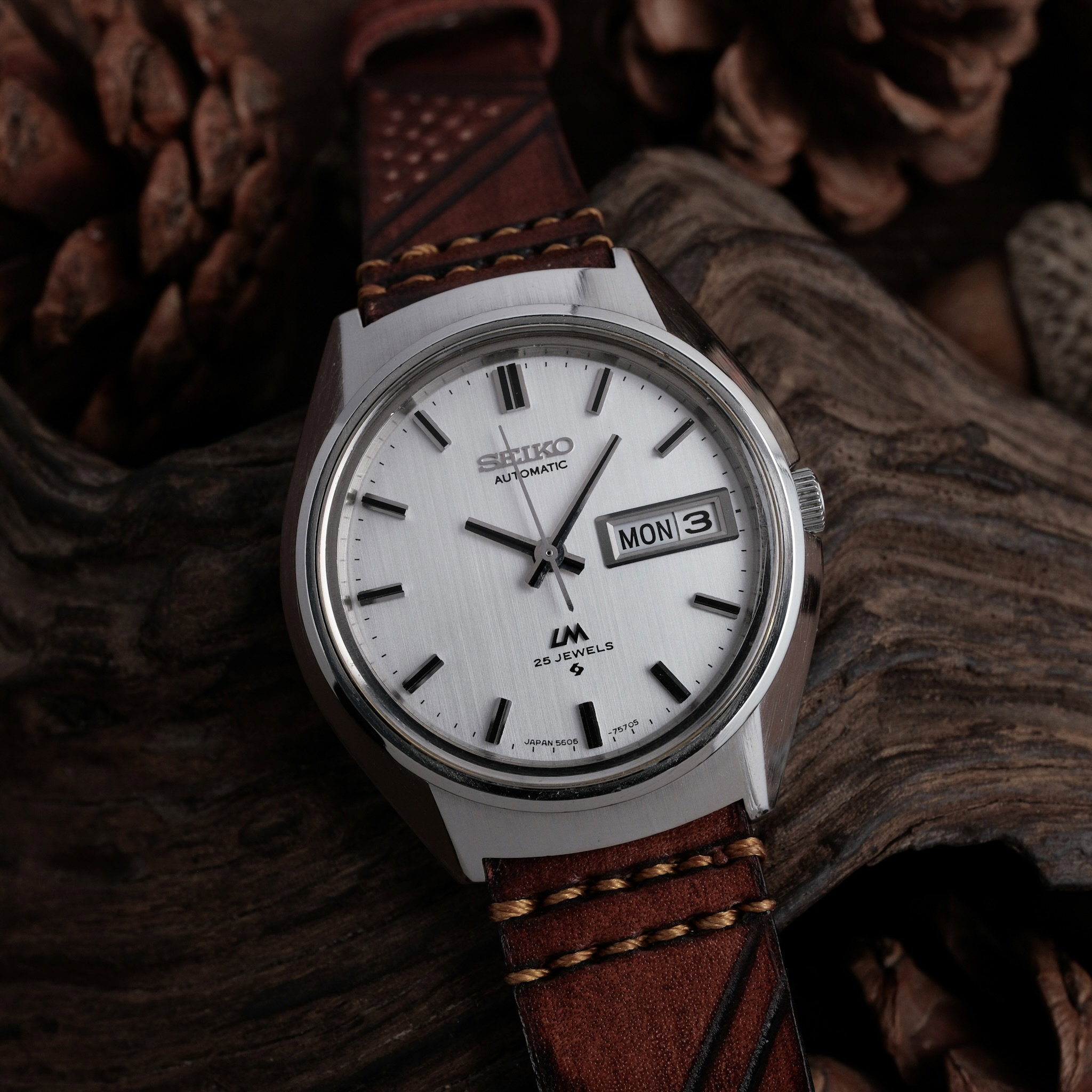
The Seiko Lord Matic 5606-7240 to buy is the sharp-cased 1972 example with an untouched dial, coherent handset and correctly signed bracelet.
We auction more than 100 vintage watches a week.
Get first access: new Seiko 5606-7240 drops and alerts before auctions end.
Browse 27 live Seiko auctionsThe Lord Matic 5606-7240 belongs to Seiko's high-grade automatic range, positioned below King Seiko and above the brand's more accessible daily watches. In 1972 form, its angular stainless steel case, faceted crystal and applied dial furniture deliver the period character without forcing the watch beyond a wearable 36 mm.
The real choice is between the dials. Silver sunburst versions are calmer and easier to assess, while the deep blue centre with a gold-tone track has stronger contrast and commands attention. Buy whichever surface is least altered, because a redial does more damage to this reference's appeal than normal case wear, an unsigned replacement bracelet or an unknown service history.
Brand
Seiko
Model
Lord Matic
Reference
5606-7240
Production year
1972
| Case diameter | 36 mm excluding the crown |
| Case material | Stainless steel |
| Movement | Automatic caliber 5606A |
| Known jewel markings | 23 jewels or 25 jewels |
| Dial variants | Silver sunburst, or deep blue with gold-tone track |
| Calendar | Framed day-date display; English and Kanji wheel documented |
| Crystal | Faceted crystal |
What it was built for
Lord Matic occupied a deliberate middle position in Seiko's range: more elaborate than an ordinary automatic, but below King Seiko. Reference 5606-7240 expresses that brief through applied faceted indices, a framed day-date display and caliber 5606A. Some handled movements are marked 23 jewels and others 25 jewels, so the jewel count must be judged against the complete watch rather than treated as a universal specification.
The bilingual English and Kanji day wheel makes the watch practical rather than merely decorative. Silver examples pair black-inlaid baton indices with hands carrying matching dark stripes, improving separation against the sunburst surface. The blue and gold-tone version works differently, using a dark central field and contrasting minute track to create a more graphic face.
On the wrist
At 36 mm excluding the crown, the 5606-7240 wears compactly but not anonymously. The broad dial opening, angular case lines and faceted crystal give it more visual width than the number suggests, while the day-date aperture keeps the layout recognisably functional. It suits a cuff more naturally than a taller sports watch, although no thickness figure is established by the watches handled.
The bracelet changes the result substantially. A correctly signed period bracelet continues the case's early 1970s geometry, whereas a generic replacement makes the head look isolated and removes part of the reference's design. Exact bracelet originality cannot be established without documentation, so period-correct construction and convincing end-link fit are safer claims than an unsupported blanket promise.
What goes wrong
The costliest fault is a refinished dial, especially when the sunburst texture, minute printing or framed day-date opening has been disturbed. Silver surfaces should remain evenly radial, and the blue and gold-tone layout should retain a clean boundary between its fields. A genuine service dial is not the same as a redial, but neither should be sold as the dial that necessarily left the factory with that case.
Over-polishing removes the angular case transitions that give the 5606-7240 its wrist presence. Soft lugs, blurred brushed-to-polished boundaries and a poorly fitting bracelet are separate faults, not attractive ageing. Faceted crystals also deserve scrutiny because replacement geometry can change the dial's reflections. Service history is unknown unless paperwork accompanies the watch, and a running caliber 5606A does not by itself establish when it was last maintained.
Dating this watch
| Serial range / caliber | Year | Note |
|---|---|---|
| 5606 | 1968-1976 | caliber production window |
Dating data comes from our decoder tables; treat years as approximate.
What to check before you buy
- Dial construction: Silver dials should show a coherent radial sunburst with applied faceted baton indices, while blue versions use a deep blue centre and gold-tone track. Flat paint, disturbed texture or rebuilt printing indicates a redial.
- Hands and calendar: On the silver configuration, the baton hands carry dark central stripes that correspond with the black inserts in the applied indices. The framed day-date opening must sit cleanly in the established dial layout.
- Case geometry and crystal: The stainless steel case should retain distinct angular transitions rather than soft, mushy lugs. The faceted crystal must also have geometry that works with the dial, since a plain replacement changes the reference's reflections.
- Movement identity: The automatic movement should be marked caliber 5606A on the examples described here. Both 23-jewel and 25-jewel markings are documented, so jewel count alone neither proves authenticity nor establishes a franken watch.
- Bracelet fit: A signed period bracelet should meet the case without conspicuous end-link gaps and should continue its angular design. Period-correct is not proof of originality, and an undocumented bracelet should not support an all-original claim.
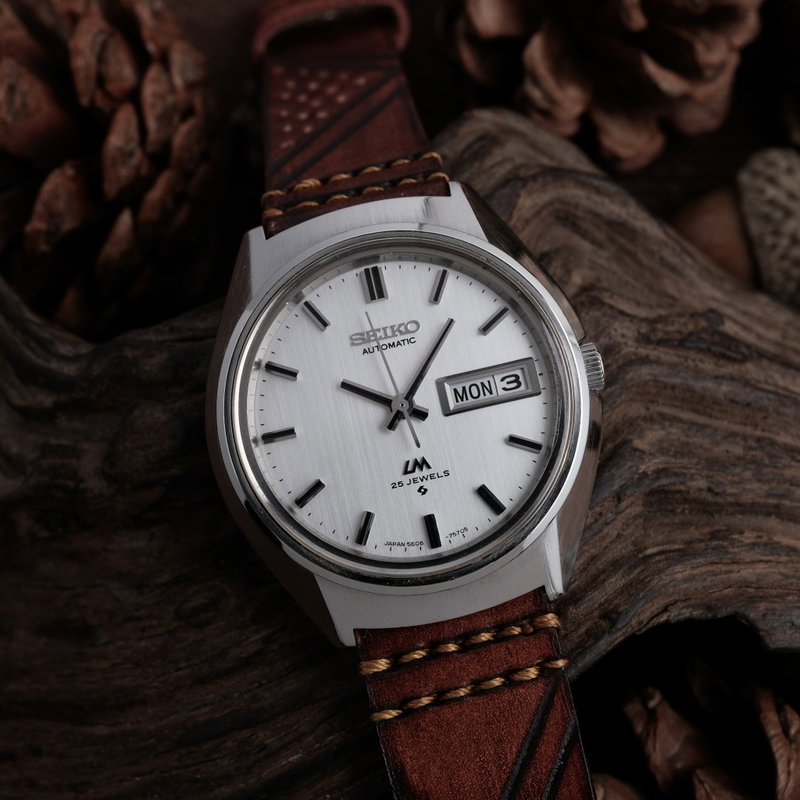
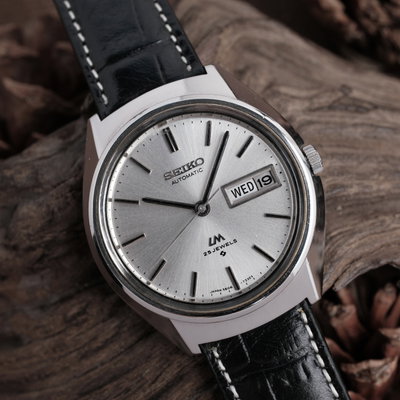
Other 5606-7240 examples we auctioned
4 Seiko 5606-7240 auctioned
More Seiko references
Related pages
Frequently asked questions
Ready to hunt for your own?
More than 100 vintage watches go under the hammer every week.