Vintage Rado Montana: Dials, References and Buying Priorities
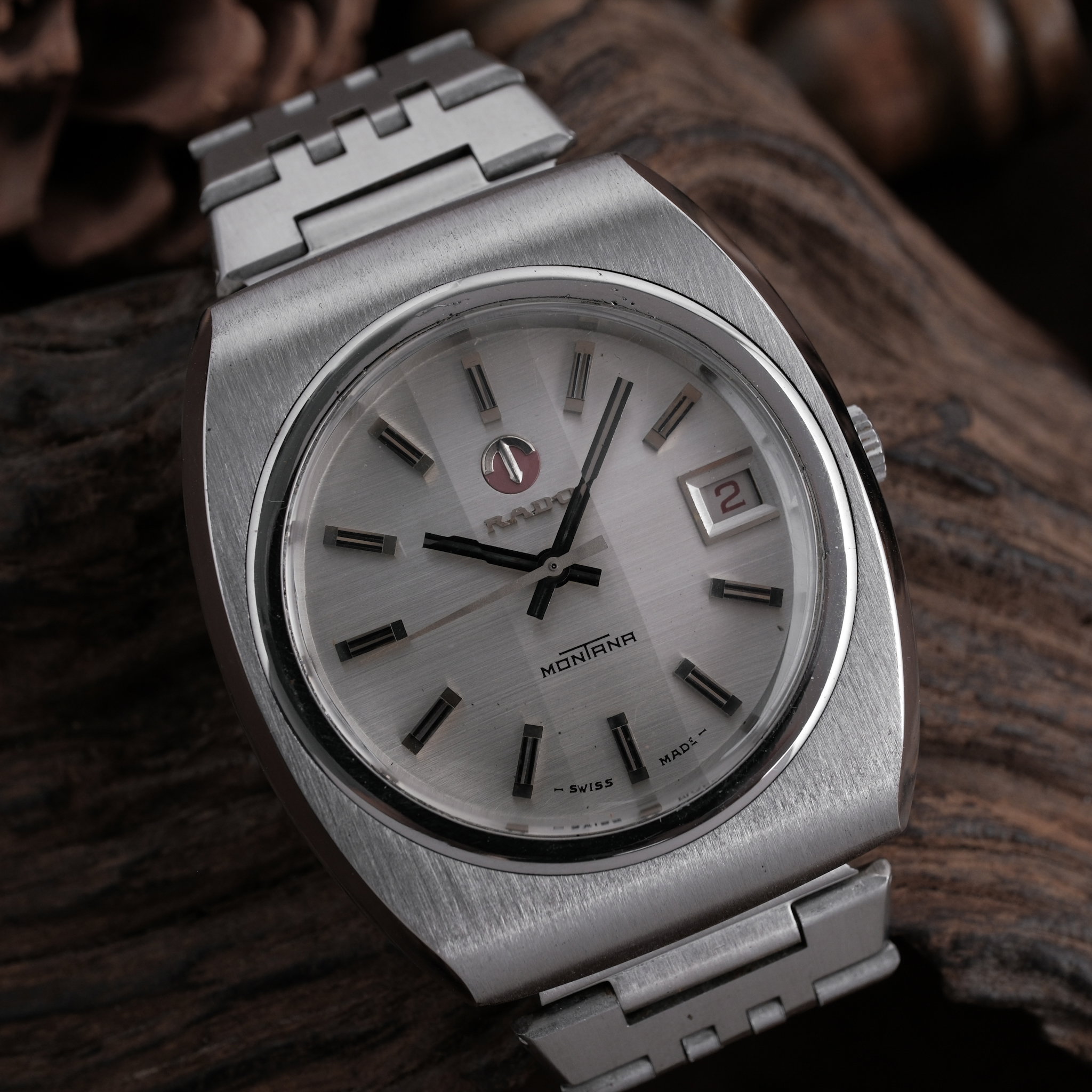
Choose a vintage Rado Montana for its dial first: crisp vertical brushing, intact printing and the correct red date matter more than cosmetic case shine.
We auction more than 100 vintage watches a week.
Get first access: new Rado watch drops and alerts before auctions end.
Browse 23 live Rado auctionsThe Montana earns its place through the dial rather than the badge. Its 1970s combinations include grey-to-brown fumé and vertically brushed silver, both set off by applied indices, a rotating Rado anchor and red date numerals.
Reference 633.3041.4 gives the clearest choice between those two dial treatments, while 11950/1 pairs a brown gradient dial with vertical brushing. Buy the cleaner dial before the sharper-looking case: a redial destroys the surface effect that separates a good vintage Rado Montana from an ordinary automatic.
The documented stainless steel cases measure 36 mm excluding the crown. Cushion and tonneau geometry add visual width, while signed mesh or integrated bracelets preserve the broad, continuous profile intended for these 1970s designs.
Model
Rado Montana
Production period documented
1970s
Known references
11950, 633.3041.4, 11950/1
Documented case size
36 mm excluding the crown
| Case material | Stainless steel |
| Movement | Automatic ETA caliber 2824 |
| Documented jewel count | 25 jewels on 633.3041.4 |
| Dial configurations | Grey-to-brown fumé, brown gradient and vertically brushed silver |
| Date display | Red date numerals at three o'clock |
| Bracelet configurations | Signed mesh, signed bracelet and integrated bracelet |
What it was built for
The Montana belongs to Rado's 1970s design language: substantial stainless steel, geometric casework and dials that change with the light. The automatic caliber 2824 and date at three make it practical, but the red date numerals and rotating anchor keep it from reading like a generic period watch.
Vertical brushing is functional as well as decorative. It gives the brown gradient dial of 11950/1 a directional texture, while the silver 633.3041.4 uses the same effect to create contrast without adding another colour. Applied indices provide depth on both versions.
Where the value sits
Dial preservation carries the premium. On 633.3041.4, the choice is between grey-to-brown fumé and vertically brushed silver; neither deserves a premium merely for colour, but crisp printing, an undisturbed brushed surface and intact applied furniture do. A refinished dial costs more in lost appeal than light case wear.
Bracelet completeness comes next. A signed mesh bracelet suits the cushion case, while an integrated bracelet makes replacement difficult because generic end links cannot reproduce the original fit. Stretch, damaged mesh or loose attachment should therefore count more heavily than superficial scratches.
Case definition matters after the dial and bracelet. Polishing first softens the transitions around a tonneau or cushion case, and repeated work can make the edges mushy. Moisture spotting on the dial, oxidised hands and degraded luminous material are separate faults, not patina.
Where to start
Start with 633.3041.4 if you want the broadest documented choice: the reference occurs with both fumé and silver vertically brushed dials, caliber 2824 and red date numerals. Between a clean silver dial on its integrated bracelet and a spotted gradient dial with a sharper case, take the silver watch.
Choose 11950/1 when the brown gradient and vertical brushing are the main attraction. Its documented 36 mm stainless steel case, signed bracelet and caliber 2824 make the decision straightforward, but the exact service history remains unknown without supporting paperwork. The movement's current performance still requires measurement rather than assumption.
What to check before you buy
- Dial surface and printing: The dial should retain either a visible vertical brushed grain or a coherent grey-to-brown gradient, depending on configuration. Flat paint, blurred printing or brushing that runs through printed text points to a redial.
- Applied furniture and date: Known configurations use applied indices, an applied rotating Rado anchor and red date numerals at three. These parts must agree with the specific dial version, although matching components alone do not exclude a franken watch.
- Hands: Documented hand sets vary by dial: black-striped batons occur with the fumé dial, while black batons occur with the silver dial. A different set is not automatically wrong, but mismatched style, corrosion or fresh relume needs explanation.
- Case and bracelet fit: The 36 mm stainless steel case should retain readable cushion or tonneau transitions rather than rounded, mushy edges. Mesh or integrated bracelet attachments should meet the case cleanly without improvised gaps or ill-fitting end links.
- Movement: Handled examples of 633.3041.4 and 11950/1 use automatic ETA caliber 2824. The evidence does not establish a unique rotor engraving or finishing pattern, so the caliber marking is more useful than decorative assumptions.
- Crown and caseback limits: The available evidence does not establish one crown or caseback configuration for every Montana reference. A signed crown may be period-correct or replaced, and neither component should authenticate the watch by itself.
Recent Rado results
7 Rado watches auctioned


More Rado references
Related pages
Frequently asked questions
Ready to hunt for your own?
More than 100 vintage watches go under the hammer every week.