Vintage Rado Kapell: dials, cushion cases and ETA movements
The vintage Rado Kapell to buy has a clean period dial, a defined steel cushion case and the correct ETA automatic movement for its reference.
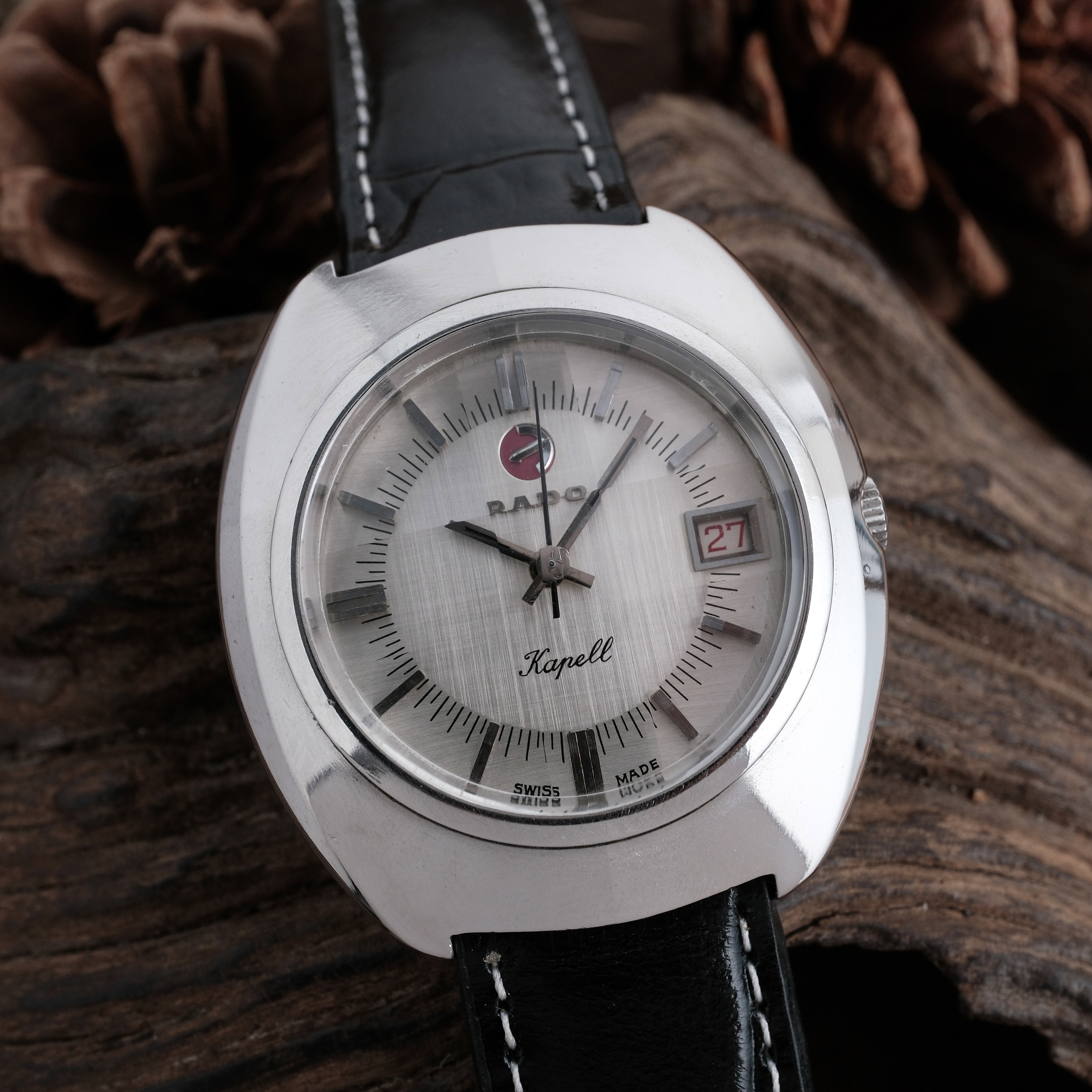
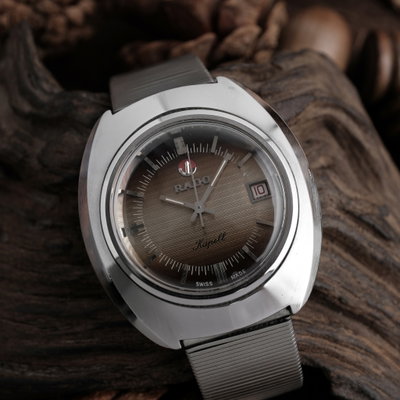
The Rado Kapell belongs to the experimental side of 1970s watch design: a steel cushion case, applied faceted indices and a rotating anchor give it a clear identity without making it difficult to wear. Kapell examples handled by Second Vintage include silver, grey, brown gradient and purple dials, so the buying decision begins with configuration rather than a single definitive look.
The cleanest route is a stainless-steel example with an undamaged sunburst or textured dial and a case that still shows its intended geometry. Known examples use ETA 2783 or 2824 automatic movements and measure either 36 mm or 38 mm excluding the crown. A refinished dial costs more in lost value than ordinary case wear, while a damaged coloured dial cannot be dismissed as harmless patina.
Known production year
1975-1975
Case material
Stainless steel
Known case sizes
36 mm and 38 mm, excluding the crown
Case form
Cushion-shaped
| Known movements | Automatic ETA 2783 and ETA 2824 or 2824 base |
| Documented dial finishes | Silver sunburst, grey sunburst, brown gradient with horizontal texture, and vertically brushed purple |
| Documented dial furniture | Applied faceted indices and rotating Rado anchor |
| Documented bracelet option | Signed mesh bracelet |
| Documented date detail | Red date numerals on some configurations |
What it was built for
The Kapell was built as a 1970s automatic watch with visual weight rather than tool-watch hardware. Its cushion-shaped steel case frames broad sunburst, brushed or horizontally textured dials, while applied faceted markers and the rotating Rado anchor add depth. Certain examples also carry red date numerals, a small detail that matters because it sharpens the period character without reducing everyday legibility.
Movement choice follows the reference rather than a hierarchy of prestige. The 6044054-1 uses an automatic ETA 2783, while 6061285a and 11054 use caliber 2824. The 6059844 A has an ETA 2824 base. Movement condition still matters, but a clean dial and coherent configuration carry more weight because routine mechanical work cannot reverse moisture staining or recreate the original surface.
Where the value sits
Value is concentrated in the dial. Grey sunburst examples of 6061285a offer the restrained option, while the brown gradient and horizontal texture of 6059844 A or the vertically brushed purple dial of 11054 deliver more period character. Between a clean grey dial and a stained purple one at the same money, take the grey: colour does not compensate for moisture damage.
Original signed mesh bracelets add interest to the 38 mm configurations, particularly when the end fit and clasp remain coherent. They should not outweigh a compromised dial or a case with heavily rounded edges. The reference field is broad, with few repeated examples among watches handled, so premiums should attach to preservation and a convincing parts relationship rather than to an unsupported rarity claim.
Where to start
Start with 6061285a if you want the easiest Kapell to wear: its 36 mm steel cushion case and grey sunburst dial are less visually forceful than the larger, more colourful variants. At 38 mm, 6044054-1, 6059844 A and 11054 put more metal and dial on the wrist. The larger case makes the cushion outline more obvious, especially beside a mesh bracelet.
For a stronger 1970s statement, 6059844 A is the configuration to seek against a damaged coloured alternative. Its brown gradient, horizontal texture, red date numerals and signed mesh bracelet form a coherent package. Buy it only when the dial remains free of meaningful spotting and the bracelet has manageable stretch. The service history of any individual watch is unknown without dated paperwork, and no inference from current timekeeping can replace that record.
What to check before you buy
- Dial and reference coherence: A 6061285a should correspond to a grey sunburst dial, applied indices, rotating anchor, 36 mm steel cushion case and caliber 2824. A different combination is not automatically false, but without documentation we prefer not to speculate beyond the watch itself.
- Movement match: The 6044054-1 is known with automatic ETA 2783, while 6061285a and 11054 are known with caliber 2824 and 6059844 A with a 2824 base. A movement outside those handled combinations needs stronger evidence before the watch can be treated as coherent.
- Dial surface and printing: Sunburst rays, vertical brushing or horizontal texture should remain continuous beneath the printed text and applied furniture. Blurred printing, disturbed texture around markers or a flat modern-looking surface can indicate a redial rather than a genuine service dial.
- Hands, lume and date display: Baton hands with luminous inserts should make visual sense beside the dial furniture. Oxidised hands and degraded lume are damage, while bright replacement lume can signal a relume. Red date numerals are correct on some known configurations, not every Kapell.
- Case geometry: The steel cushion case should retain defined transitions around its broad upper surface and sides. Repeated polishing softens those edges and makes the outline look swollen. Compare that geometry before giving weight to superficial shine.
- Caseback, crown and bracelet relationship: Signed components should be assessed as a group rather than accepted individually. A signed mesh bracelet adds confidence only when its fit and clasp are coherent, while replacement crowns are possible consumables and must not support a blanket all-original claim.
Recent Rado results

Rado · Kapell · 11054

Rado · Kapell · 6040993
Rado · Kapell · 6048808-1

Rado · Kapell · 6061285a
Rado · Kapell · 40560529
Rado · Kapell · 6059314A

Rado · Kapell · 6064201A
Rado · Kapell · 6059844 A
More Rado references
Related pages
Frequently asked questions
Ready to hunt for your own?
More than 100 vintage watches go under the hammer every week.