Rado Spacewing: the 1970s references and dial variants worth knowing
Buy the dial first: a sharp steel Spacewing with a coherent red-date configuration is safer than a rarer colour with refinishing or softened case lines.
Live now
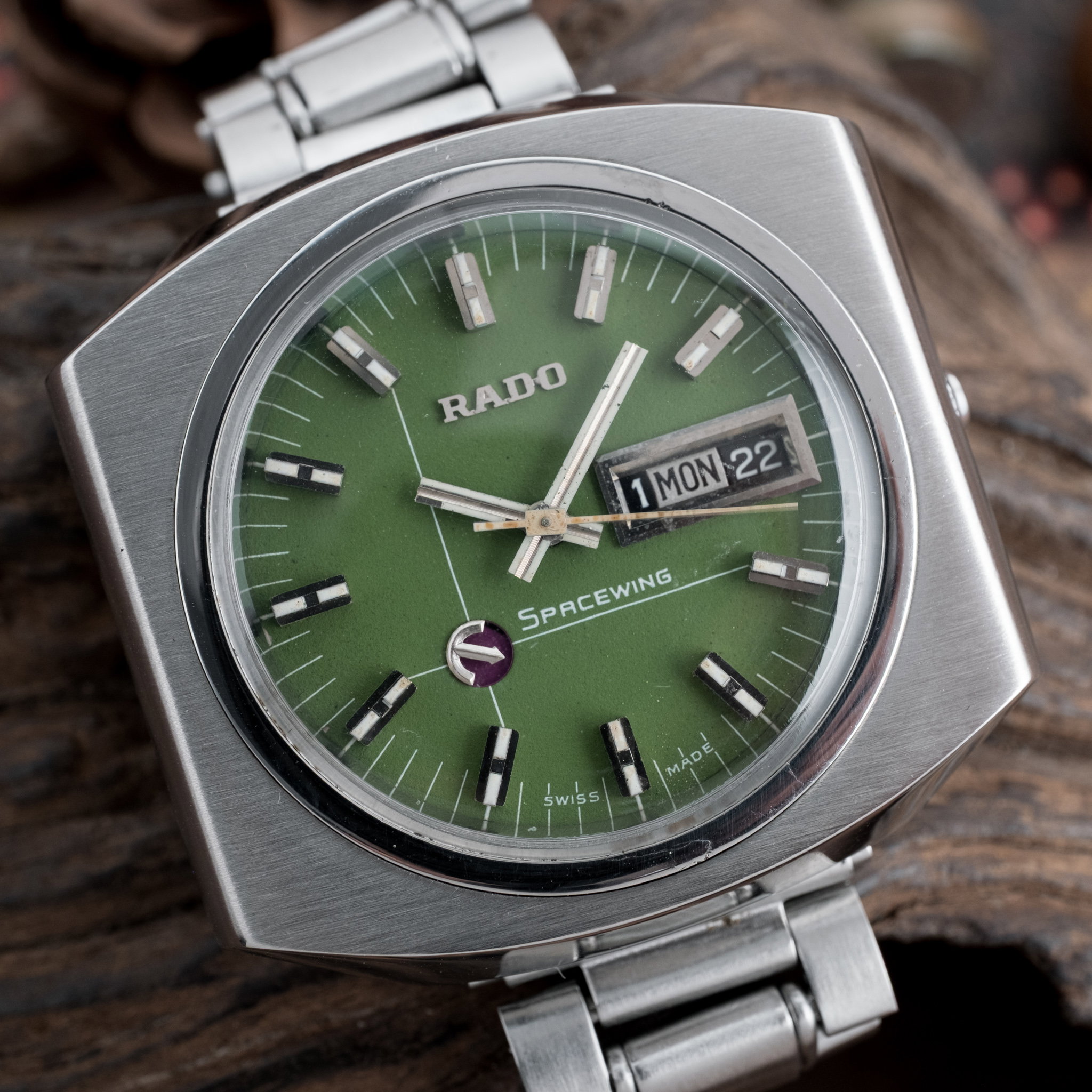
The Rado Spacewing belongs to 1970-1974, when its cushion and tonneau cases gave a modest steel automatic far more visual width. The name also appears as SpaceWing, but the buying decision remains the same: prioritise a coherent dial, hands, case and movement over spelling or surface shine. Silver, burgundy and grey gradient dials make this a model where colour changes the character substantially.
Most examples measure 35 mm without the crown, while reference 733531 reaches 36 mm. That single millimetre matters less than the broad shoulders, faceted indices and strong minute-track graphics. The red date and rotating Rado anchor add colour without sacrificing legibility, although a refinished dial costs more in lost appeal than ordinary case wear. Used Rado Spacewing examples therefore need judging as complete configurations, not as loose collections of attractive parts.
Production years
1970-1974
Case sizes
35 mm and 36 mm, excluding the crown
Case material
Stainless steel
Movement type
Automatic
| Known calibers | AS 1858 and ETA 2783 |
| Known jewel count | 25 jewels on documented automatic examples |
| Case forms | Cushion and tonneau |
| Dial finishes | Brushed silver, silver sunburst, burgundy vertical-brushed and grey gradient |
| Date display | Red date, including at 3 o'clock on references 733982 and 745394 |
What it was built for
The Spacewing was built as an automatic steel watch with the visual language of the early 1970s rather than the proportions of a conventional round dress model. Cushion and tonneau cases frame brushed or sunburst dials, while applied faceted indices and a red date provide contrast. Reference 740741 pairs a vertically brushed silver dial with a blue minute track; reference 733531 uses horizontal brushing in a slightly wider case.
This is still a compact watch. At 35 mm without the crown, references such as 733982 and 745394 sit close to the wrist, but their broad case geometry occupies more horizontal space than a round watch of equal diameter. The baton hands remain legible against silver or grey, while the black centre stripes used on reference 733982 tie the hands to its applied indices.
Where the value sits
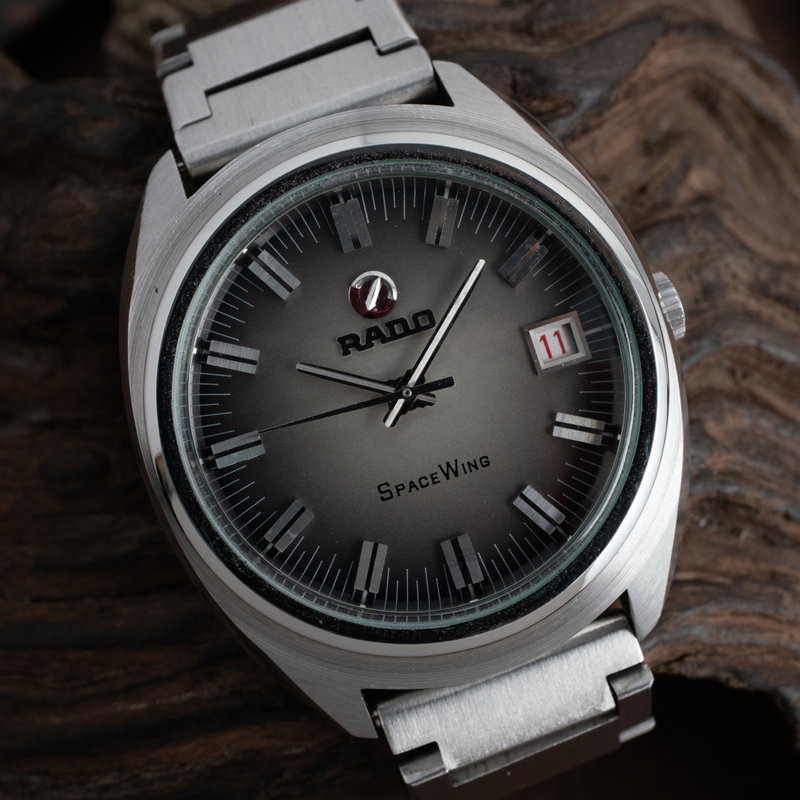
Dial preservation carries the largest share of value because the Spacewing's identity depends on finish and colour. Reference 735487 uses deep burgundy with vertical brushing, while reference 745394 has a grey gradient dial, applied faceted indices and a red date. A redial can reproduce the colour broadly yet lose the brushing, gradient transition or crisp print that makes the correct configuration convincing.
Completeness matters next. The signed stainless steel mesh bracelet paired with reference 745394 adds more than an unsigned replacement, although bracelet presence should never excuse a damaged dial. Sharp case lines also deserve a premium over bright polishing: once the shoulders become soft and the transitions lose definition, no service puts the removed steel back. Between a clean silver dial in a defined case and a damaged gradient dial in a polished one, take the silver watch.
Where to start
The safest starting point is a 35 mm stainless steel Spacewing with a silver dial, blue minute track and red date, provided the configuration remains internally consistent. Reference 733982 makes that choice easy to understand because its AS 1858 automatic, sunburst dial, black-striped baton hands and signed anchor crown form a specific combination. It is easier to assess than a colour dial whose gradient or brushing may have been recreated.
Buy the burgundy 735487 or grey gradient 745394 only when the dial surface is clearly stronger than the case wear. Plating loss is not an issue on the documented stainless steel cases, but polishing can still soften the shoulders, replacement crowns can erase a useful reference point, and bracelets can develop stretch. Service history is often unknown, so timekeeping and movement condition need treating separately from cosmetic quality.
What to check before you buy
- Dial configuration: Reference 733982 should be assessed as a combination of silver sunburst finish, blue minute track, applied faceted indices and red date. Correct-looking individual parts do not establish a coherent watch if that combination has been mixed.
- Hands and indices: On reference 733982, the baton hour and minute hands carry black centre stripes that correspond with the black-striped applied indices. Plain replacement hands weaken the configuration even when their length looks plausible.
- Case geometry: Reference 733531 is documented at 36 mm, while references 740741, 733982, 735487 and 745394 are 35 mm without the crown. Size alone does not authenticate one, but soft shoulders and blurred transitions disclose polishing.
- Crown: Reference 733982 has been handled with a signed Rado anchor crown. Crowns are consumable parts, so an unsigned replacement is not proof of a fake, but it reduces completeness and should not be described as original.
- Movement match: The AS 1858 belongs with the documented 733982 configuration, and the ETA 2783 with reference 745394. A different automatic movement may indicate a replacement, a married watch or a franken assembly and needs separate evidence.
- Redial and franken tells: Brushing direction is reference-sensitive: 733531 has horizontal silver brushing, 740741 vertical silver brushing and 735487 vertical burgundy brushing. A dial that borrows the colour from one and layout from another is a franken warning, not harmless variation.
Recent Rado results
19 Rado watches auctioned
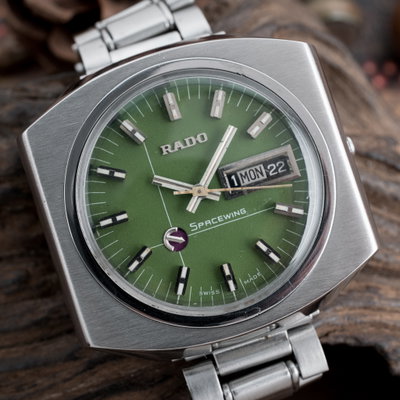
Rado · Spacewing · 11910
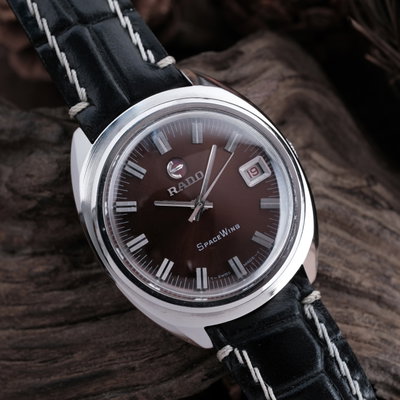
Rado · SpaceWing · 735487
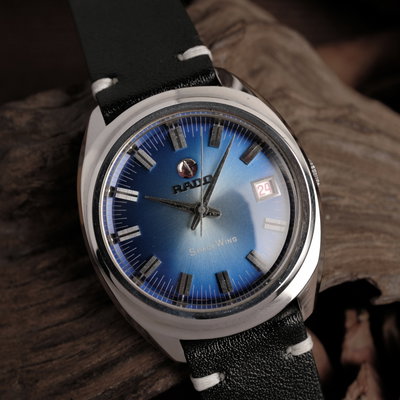
Rado · Spacewing · 745991-1
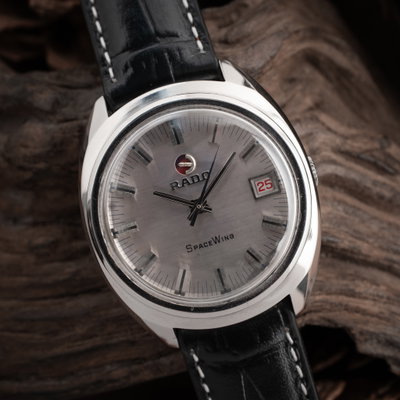
Rado · Spacewing · 740741
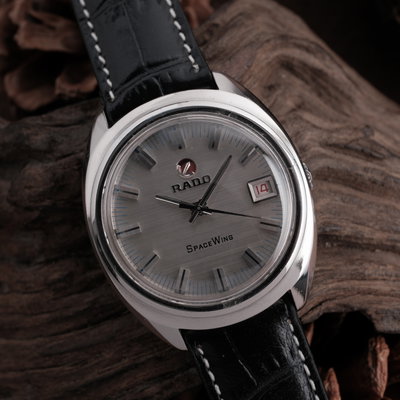
Rado · Spacewing · 733531
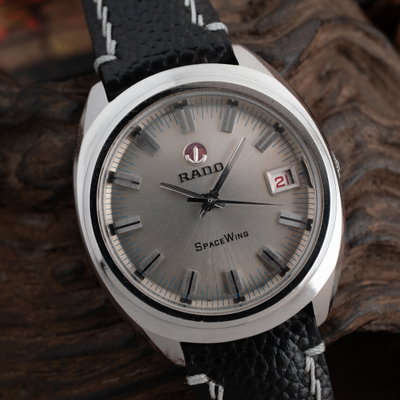
Rado · SpaceWing · 733982
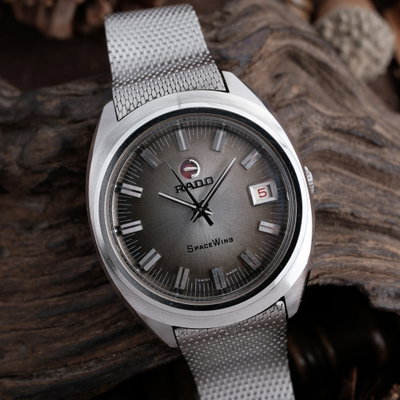
Rado · Spacewing · 745394
We auction more than 100 vintage watches a week.
Get first access: new Rado watch drops and alerts before auctions end.
More Rado references
Related pages
Frequently asked questions
Ready to hunt for your own?
More than 100 vintage watches go under the hammer every week.