Oris 7403-40B Pointer Date Reference Guide
The Oris 7403-40B is a 1990s steel Pointer Date whose value rests on its guilloche dial, correct caliber 574 and credible mechanical condition.
We auction more than 100 vintage watches a week.
Get first access: new Oris 7403-40B drops and alerts before auctions end.
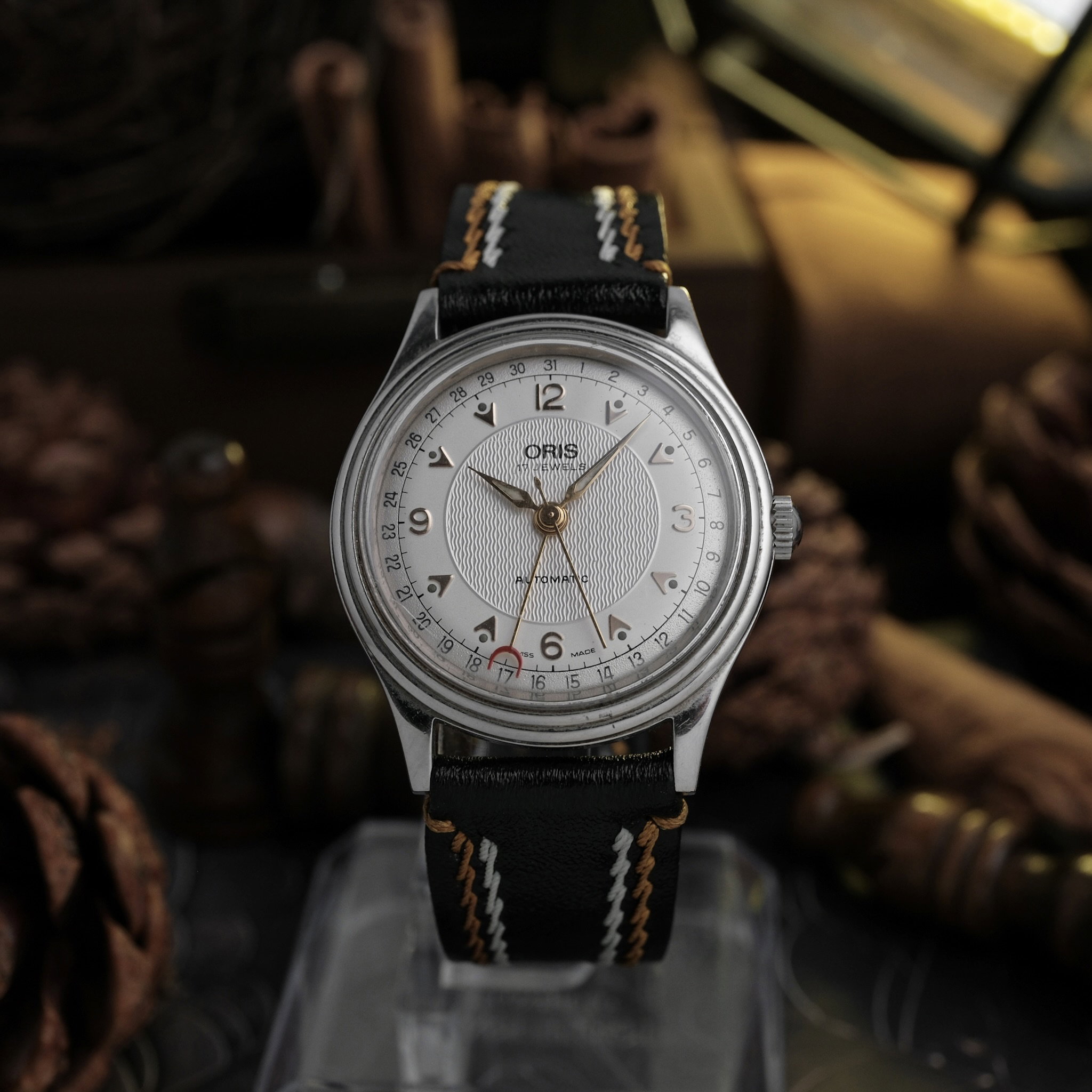
A dedicated hand reads the date from the outer track, while the silver guilloche centre and applied gold-tone furniture give this 1990s Pointer Date a dressier character than a plain three-hand watch.
For a vintage Oris 7403-40B, the dial is the decisive component. The correct combination is a silver textured centre, applied gold-tone Arabic numerals and dart indices, and an outer date track printed in blue. A used Oris with a clean dial and sound caliber 574 is the one to buy against a sharper-looking example with refinished printing or weak timekeeping.
Brand
Oris
Model
Pointer Date
Reference
7403-40B
Production period
1990s
| Case material | Stainless steel |
| Case size | 34 mm excluding the crown |
| Movement | Automatic Oris caliber 574 |
| Jewel count | 17 jewels |
| Dial | Silver guilloche centre with applied gold-tone numerals and indices |
| Date display | Central pointer hand with blue outer date track |
| Caseback | Exhibition caseback |
The model landscape
Reference 7403-40B is a compact stainless-steel Pointer Date from the 1990s, powered by the automatic Oris caliber 574. The exhibition back matters because the movement is part of the watch's identity rather than a hidden substitute. The dial layout is equally specific: silver guilloche at the centre, gold-tone applied furniture around it and a blue date scale at the edge.
The value sits first in an honest dial, then in mechanical health. A redial can reproduce the broad layout while losing the guilloche definition or changing the blue date printing, and that costs more than ordinary case wear. A genuine service dial is different from a redial, but without documentation or a known factory comparison, the watch itself may not establish when a replacement was fitted.
There is little reason to trade dial quality for cosmetic case shine. Between a 7403-40B with crisp printing and minor steel-case wear, and one with a bright polished case but uncertain dial work, take the former. The decorated caliber 574 should also match the reference; a different movement would make the watch franken rather than merely serviced.
On the wrist
At 34 mm excluding the crown, the 7403-40B wears as a compact dress watch rather than a modern sports watch. The pointer-date scale uses the dial's full diameter, so the face carries more information than its case measurement suggests. Gold-tone alpha hands and applied numerals maintain contrast against the silver centre, while the blue outer track separates the calendar reading from the time display.
Its scale suits a cuff, but legibility depends on intact contrast: dulled hands, missing luminous dots or a faded outer track matter more here because the display is already dense. The exhibition back adds visual interest off the wrist without changing the restrained proportions from above.
What goes wrong
The largest financial fault is a refinished dial, especially where the blue date track has been reprinted or the textured silver centre has lost definition. Missing or degraded luminous dots also interrupt the original hour layout. On the case, repeated polishing rounds the lug edges and removes steel permanently, so a bright surface should not be confused with well-preserved geometry.
Mechanical performance varies enough to require evidence from the individual watch. Examples we have handled have ranged from roughly +11 to +15 seconds per day to about -66 to -72 seconds per day. A movement can run throughout a test and still need diagnosis, and a service claim without dated documentation does not explain amplitude, positional variation or the condition of the calendar mechanism.
A replacement crown or crystal is less damaging than an incorrect dial or caliber, since both are service parts, but neither should support a blanket claim of originality. Confirm that the pointer advances and aligns with the outer date track, and that the caliber visible through the back is 574. Buy the clean original-format dial and stronger movement against polished steel and unsupported service language.
What to check before you buy
- Dial configuration: The correct format has a silver guilloche centre, applied gold-tone Arabic numerals and dart indices, with a blue pointer-date track at the perimeter. Flat texture or crude blue printing warrants caution.
- Hands and date display: Gold-tone alpha hour and minute hands belong with the applied dial furniture, while a separate central pointer reads the outer date track. The date pointer should advance and align with that scale.
- Case and proportions: The case is stainless steel and measures 34 mm excluding the crown. Rounded lug edges indicate polishing, while a different material or materially different proportion does not match the handled configuration.
- Movement and caseback: The exhibition back should reveal the decorated automatic Oris caliber 574 with 17 jewels. Another caliber would not match reference 7403-40B, even if the dial and case look convincing.
- Redial and franken tells: Uneven blue date printing, reduced guilloche definition or mismatched hands can indicate refinishing or mixed parts. A genuine service dial is factory-made, while a franken combines parts that never shipped together.
Other 7403-40B examples we auctioned
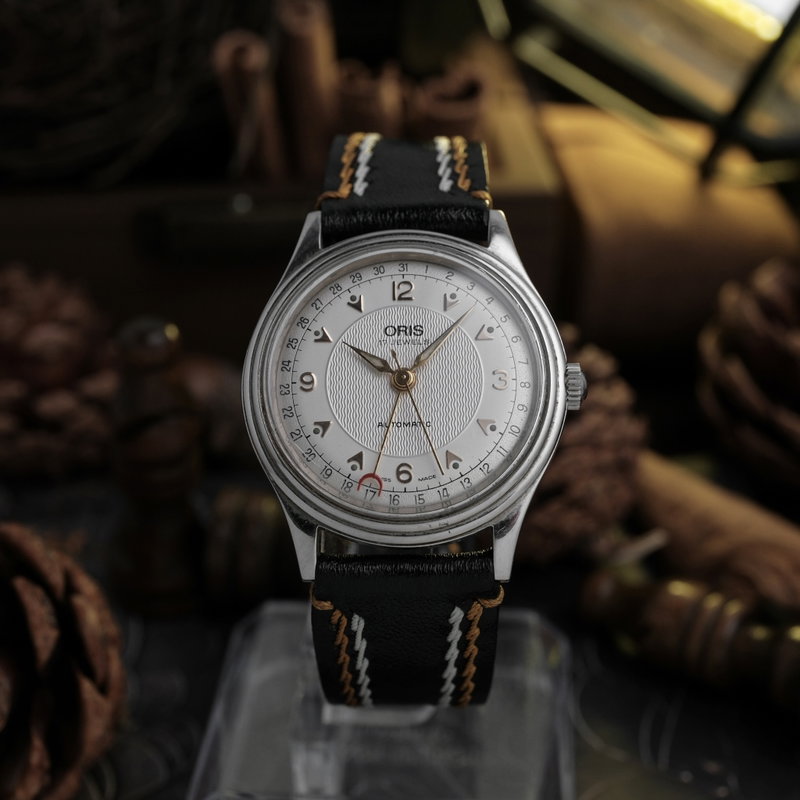
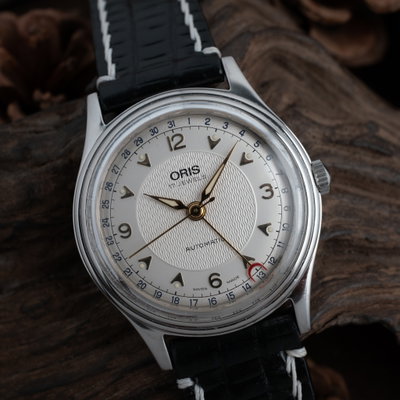
3 Oris 7403-40B auctioned
Related pages
Frequently asked questions
Ready to hunt for your own?
More than 100 vintage watches go under the hammer every week.